
Liberation Defined
The whole point of this Substack

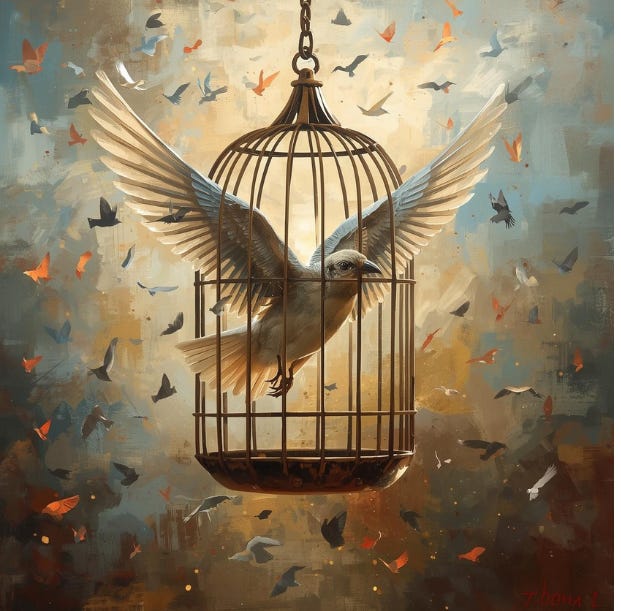
Liberation.
Many cultures focus on it. Some religions promise it. It’s called by different names in different eras. But what does it really mean?
My little corner of the Internet is named “Liberation Library” for a pretty big reason. I’d like to keep focusing on it not only as a concept but a practice.
Liberation is presented as a noun but its not an object. It’s not even a static destination. I don’t believe that one day we will achieve a perfect state of society where harm no longer exists; where we all hold hands and everyone is happy all the time. I’m sure my brain would love to believe that certainty exists but that’s not real.
Liberation is meant to be a verb. Liberate.
But what are we liberating ourselves from? The simple answer is oppression. We live in a time where systems oppress many and benefit few. I often see it through this very simple set of visuals:
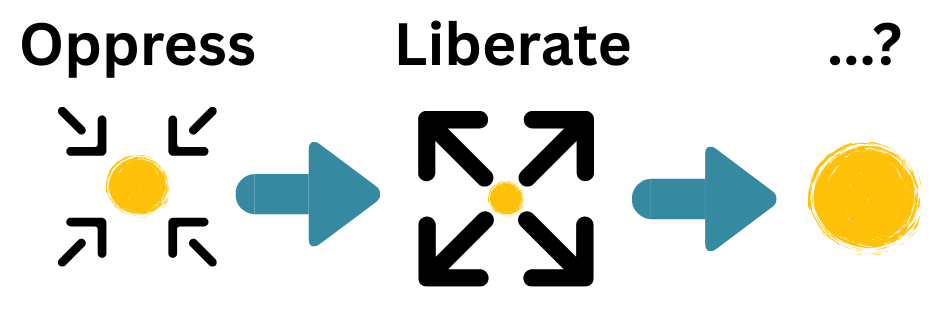
If I imagine it in this verb tense, what happens after said thing expands back out from its confined state? What comes after liberating? It doesn’t keep liberating out and out and out. It goes back to its original state. And what is our original state when we aren’t oppressed or oppressing each other?
I believe connection is our original state.
Let me explain. In grad school, a recently published text put these thoughts all into perspective for me. In Liěn Shutt’s book, “Home is Here: Practicing Antiracism with the Engaged Eightfold Path”, she describes oppression as fragmentation. Oppression is about cutting us down and making us smaller.
On the other end, she describes liberation as returning to wholeness. Liberation is always present and possible in any moment. We can be whole in any moment if we can reconnect back to the part of us that is getting cut away.
My brain just about exploded. 🤯
Because wholeness is about connecting back to the pieces of ourselves we lost or cut ourselves off from because they weren’t deemed good enough. Wholeness is about connecting back to the humanity in each other. If we were to create systems that support wholeness, everyone would get to be who they are and would get the accommodations to support their way of being as a matter of default.
Shutt says that when we are whole, we are home. We belong fully to ourselves again.
After reading that, it became clear to me that I want to internalize all the practices that will bring me back home. I want to be whole again.
I hope to document here what I am learning about liberation, how I’m practicing coming into my wholeness, the reflections I have in my imperfect embodiment along the way, and hopefully a source that inspires others to do the same. I hope we can add to each other’s journeys. I offer in my writing what I do and think and feel to help us each remember we are not alone. We are whole. We can restore each other and in doing so, create a whole system. That reality of wholeness is present and possible.
This Substack will help me keep orienting to and beyond liberation. I know I’ll forget, take wrong paths, and rediscover over and over again. I hope though that I’ll keep moving forward on the path. Writing about it and keeping it on my mind will help me keep on keeping on.
This Substack will be a collection of tools, practices, and strategies I implement as it pertains to both liberating and connecting that others can easily access.
Maybe we will constantly need to remind each other how to get home. And maybe that’s the part of life I’ll come to love. Maybe that’s where the living happens.
As Ram Dass said, ‘We are all just walking each other home.’
I hope you’ll join me. And share your reflections with me too as we make our way back home. Together.
We have never needed this more. Thank you! I so look forward to your future posts in this space.